
Amniotic Fluid Index (AFI)
An ultrasound procedure used to assess the amount of amniotic fluid. The amniotic fluid index is measured by dividing the uterus into four imaginary quadrants (Figure 1). The linea nigra is used to divide the uterus into right and left halves, and the umbilicus serves as the dividing point for the upper and lower halves.
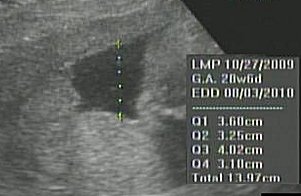
The transducer is kept parallel to the patient’s longitudinal axis and perpendicular to the floor. In each quadrant, the deepest unobstructed vertical pocket of fluid is measured in centimeters (Figure 2). The four pocket measurements are then added to calculate the AFI. Normal AFI values range from approximately 5 to 25 cm [1, 4].
Based on available data from randomized controlled trials, the American College of Obstetricians and Gynecologists (ACOG) supports the use of the deepest vertical pocket (DVP) of amniotic fluid volume of 2 cm or less to diagnose oligohydramnios, rather than an AFI of 5 cm or less.

References
- Rutherford SE, Phelan JP, Smith CV, Jacobs N. The four-quadrant assessment of amniotic fluid volume: an adjunct to antepartum fetal heart rate testing. Obstet Gynecol. 1987;70(3 Pt 1):353–356. PMID: 3306497
- Phelan JP, Smith CV, Broussard P, Small M. Amniotic fluid volume assessment with the four-quadrant technique at 36–42 weeks’ gestation. J Reprod Med. 1987;32(7):540–542. PMID: 3305930
- Magann EF, et al. Ultrasound estimation of amniotic fluid volume using the largest vertical pocket containing umbilical cord: measure to or through the cord? Ultrasound Obstet Gynecol. 2002;20(5):464–467. PMID: 12423483
- Phelan JP, et al. Polyhydramnios and perinatal outcome. J Perinatol. 1990;10(4):347–350. PMID: 2277279
- American College of Obstetricians and Gynecologists. Antepartum fetal surveillance. Practice Bulletin No. 145. Obstet Gynecol. 2014;124:182–192. PMID: 24945455.